Brand Focus - Rossignol Snowboards
Back in 2005, a couple of months before my first snowboard season in the French Alps, I was bought a Rossignol Todd Richards 157 as an early Birthday present. The graphics were ok and the spec was pretty comprehensive but it was a Rossignol so I had reservations. Within a couple of weeks of riding my Burton Dominant had taken a back seat and I was riding my new Rossi day-in day-out for absolutely everything on the hill. Two whole 100+ day seasons later I had to retire the TR because I’d decided to jib some rock faces with it. Since then the brand I’ve returned to is Rossignol. I’ve since owned a JDub 158, Twilight 164 and an Angus 157. With every board I’ve owned I’ve been impressed with the durability of the boards, the quality of the materials going into the boards, the build quality and most of all the way the boards deliver great performance. Sorry this is beginning to sound like a sales pitch, I guess the point I’m trying to make is that Rossignol is a brand that has always been a little bit of an outsider in the snowboard game, those that have tried the boards on the most part have only good things to say about them, and there are those that despise the fact that Rossignol has been producing skis for decades, they feel that Rossignol has no part to play in the industry. Isn’t the saying ‘It’s where you are going, not where you have come from”?
I met Arno one of the big men behind Rossignol Snowboards at ISPO in February, he took tons of time to show me through the boards, chat about the brand and the company he works for, definitely one of the nicest people I’ve met in the industry to date. It occurred to me that it would be nice to humanise Rossi and let people decide for themselves whether Rossi is a brand they want to buy from or not, so I put together an interview for Arno.
Perhaps after reading the interview you’ll have a better or just a different opinion of Rossi, perhaps you won’t, but at least you’ll know a little bit more about Rossignol Snowboards and you can make your own mind up. At the very least you’ll get a little exclusive on two boards being put together for the coming seasons!
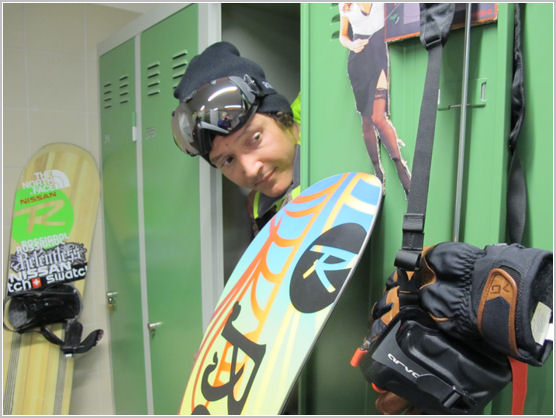
Hi Arno, how are you?
Had a new haircut at stella’s that looks fantastic.
Is the summer a busy time of year at Rossignol HQ, or are you spending a lot of time improving your tan in the south of France?
It’s a public company, so it’s never really busy… but summer’s more the wrapping up of the new lines and confirming the samples that go with it. It’s also the time when we test ride products that are 2 years away from us in the glaciers of Tignes and les Deux Alpes, so it’s all fun.
So what is your job role at Rossignol and how did you find yourself working at France’s most famous winter sports brand?
The company says I’m a product manager but I’m more a sauce cook in disguise: I make sure the product smells and tastes good and that all the ingredients hold together. I work with the head of global marketing, the creative director, the sales managers and representatives, the riders, the development team, the factories and a selection of dealers.
My story with Rossi started out in January 2000 when they bought out the company I was working with, but I only moved on to the snowboards division in 2005. I was doing the exports at Hammer snowboards since 1997 but my interest and skills were on products, not on sales…which is probably why Hammer went bankrupt by the way. I was hired by someone who’s not at the company anymore…it all hangs by a thread.
On the surface Rossignol appear to do very little to separate the snowboarding side of the business from the ski side. As a consequence, some snowboarders seem to believe that Rossignol Snowboards is a huge commercial monster that exists just to finance its investors Heli skiing trips. I think our readers would be interested to know a little more about the setup at Rossignol: How many people work on the snowboarding side of the business and how close are the ties between the ski and snowboard parts of the business? Does Rossignol’s Ski divison influence the Snowboard products?
Our division counts for 5% of the turnover, so that’s how much time we get to speak up in global meetings. The division is only 4 people, technically, with Adrien Reguis being responsible for product development and industrial processing, Fran Stoll handling all the art from Park City, Eric Hutchison overseeing the sales and products and me cooking, but that does not mean we’re not part of the bigger Rossignol blob. There’s an army of people involved, at one point or the other. So let’s be honest with ourselves: we, as the snowboard division of Rossi, would not be here without the skiers and shareholders. Same goes with the consumers. We owe them all big time. Which doesn’t mean I love them like wife and kids or close friends, I just love the sport and I love what I do. And I know how lucky I am to do what I do and live where I live. And that makes up for everything else.
On a company level, there’s a great respect between all the guys that work in all the different areas. This respect, that can sometimes cause fear in a public company, brings independence and freedom of action. We have little factories and development that we share. We go different directions and take influences from different cultures, but we always take a look at each other once in while, to make sure we’re not missing anything from the flip side of the coin…you never know these days. We’re like a hypothetical 2 swimmer relay for the company. We’re both in the same team we just have have different styles. It’s like in the park. You see snowboarders and freeskiers ride the same hits, talk to each other and have fun, but you can’t say it’s the same sport. They have little in common. We ride sideways and that says it all.
What is the history of Rossignol’s involvement in Snowboarding?
We’ve been making snowboards since 1987, stealin’ some of the best snowboarders in history, got a couple swiped, been building kickers and reputations, killing some too. So we’re more than just the big bad wolf with the 3 little pigs.
Rossignol Snowboards have had some seriously famous riders representing the brand in the past; Travis Rice, Mathieu Crepel, Chad Otterstrom, John Jackson and Jeremy Jones to name few. Despite these huge endorsements of the brand and the boards, there are still some riders that believe that no board with the ‘Rossignol’ name can be either cool or good, and these people don’t mind voicing their opinions on the net. It must be a huge effort to change people opinions; do you find that sometimes the ‘Rossignol’ name is detrimental to the Snowboarding side of the business?
When I look at K2, I find it more detrimental to be a French company with a French name than being a ski company actually. French goods are hard to sell outside of wines, perfumes and pret-a-porte (Rich – I think you forgot cheese Arno). In the mean time, it’s the people who sell the products who really make a difference, not so much the name behind them. I have more faith in people than in names. We had great momentum with Aleksi Litovaara back in the day, or with Tadashi Fuse and Andrew Crawford in the freestyle area and now with Xavier De Le Rue on the freeride scene. Life is made of ups and downs.
Trends are changing faster every year but they always come full circle. The only thing of importance to me is to have fun. And the struggle you’re implying in your question is great fun to me: I just love the idea of convincing people. It’s like mission impossible or riding a kicker or a table: you have to find the right angle or you’ll look very bad or might even crash. We’ll always look bad to some people and look great to others. We always have and always will, no matter what. It’s just the way the world goes round. Fact is that I used to be on their side before working with Rossi, so I know the feeling. I’ve heard and read what they have to say and it actually helps me take a step back and look at the company from a different perspective. I learn a lot from criticism.
Thinking back to all of the huge names which have represented Rossignol Snowboards in the past, Rossi’s current team seems to be a little on the slim side. It’s cool that Xavier De Le Rue and Jonas Emery are still on the team roster as they are huge names which have been synonymous with Rossignol for years. With the success of Rossi’s freestyle boards over the last couple of years, are there any plans to expand the freestyle aspect of the team? As the United States is obviously the biggest market for boards on the planet do Rossi plan to recruit any big name riders from one of the 50 states?
We’re not going to buy our way into big name riders anymore. Firstly, because our budget situation doesn’t allow it. Secondly, because I haven’t had a lot of big names knocking at my door lately. So we’re all about grass roots marketing and local promotion. Besides Xavier and Jonas, the team is Michal Ligocki from Poland; Hans Kestila from Finland, Enzo Nilo, TomTom and Marion Haerty from France; Neil Provo, Zack Siebert, Nick Russell, Silas Stannard, Moss Haladay, Jerome Kuntz, Robbie Danner and Alex Bayer from the US and Jeremy Coultier and Jason Dubois from Canada. So outside of Xavier, Jonas and Neil they are all in the freestyle arena and have a regional influence. This strategy has proven itself to help a great deal with the regional sales and image of the division; so we’ll keep digging in this direction until we hit something bigger
.
Jeremy Jones has always been the driving force behind Rossignols Freeride offering. Now that Jeremy has left Rossignol to concentrate on his own brand, will Freeride World Champion Xavier De Le Rue be working on the Experience and other freeride models in his place? I love my Rossi Twilight can you bring it back?
Xavier’s been working on the Experience since day 1 actually. The board was co-developed by Jeremy and Xavier. Hence the output. He’s bringing a cruising version of the Experience for 11/12 and he’s working on a new project for 12/13 that involves wood veneer and pintail… so much for the Twilight.
The Rossignol Experience in action
Looking back at last year, there’s no denying that 2009/10 was a fantastic year for Rossignol. The Angus finished second in Snowboarder Magazine’s ‘Best of Test Awards’ and first in Transworld Snowboard Magazine’s ‘Best board under $400’ in it’s highly respected Good Wood awards. Those are some pretty amazing accolades, and that’s only the print media… there was also huge amounts of praise heaped on the Angus and the Experience on the web. How did the Angus’s revolutionary Amptek profile come about, and what is driving these radical innovations and forward thinking at Rossignol?
None of this technology, and I don’t mean only Rossi, is revolutionary. It’s all moving the tip and tail kicks back and forth, or adding kicks along the running length. Snowboarding’s always had camber and rocker. Only rocker was called tips in the old days. The real innovation is more the Magne-Traction edges that was invented by Mervin. AmpTek came after I introduced the Micro at Hammer snowboards for winter 2005/2006 and the Mini at Rossignol snowboards a year later. Those were early versions of the Hellraiser that was introduced in our line in winter 2007/2008 and has been endorsed by the American Association of Ski Instructors (AASI) since. They were 121cm long and had an 81cm contact length. They were like the snowblades of snowboarding. Affordable, light, super easy to ride and tune, they’d fit in any trunk of any car, etc, etc. We had great success with it among the learning population, hence the fact that we now offer it as a rental, but most importantly everyone was having fun with them, which made us take a closer look at it and build prototypes that had the same contact length but longer tips to maximize stability at high speed and floatation in powder. This development led to the Angus and the AmpTek. AmpTek means Amplification Technology as it amplifies everything you do: it makes ollies higher, dramatically enhances stability at higher speed, smoothes out the landings, and keeps your board on top of the snow at all times. In short, it just makes Snowboarding more fun. That’s what drives us. Snowboarding’s all about taking the shortest road to fun. This is why it only came way after skiing. We’ve watched the Skiers work hard developing their bases and constructions and shapes and waited until they came out with industrial solutions and commercial networks to show them how it should be done. The rest came out from the skateboarding and surfing scenes, which were also established a long time ago. Snowboarding is just a better interpretation of an existing world. Call us lazy or smart (lazy’s more appropriate), we don’t care, it’s all fun. The success of AmpTek is due to the fun that comes out of it. You can almost smell the fun when you get into a store that carries AmpTek. It’s really a conjunction of basic rules. The camber between the feet is an absolute priority if you want stability at high speed and pop, and the rocker on both tips really adds to the easiness of the board both on and off the groomed snow, but it also takes a great flex pattern and a good shape outline. It is these elements that really made the Angus stand out. And the fact that we’re offering AmpTek rocker on more models this season paid off because we won 2 new Good Wood awards with the new Taipan and Justice.
For the 2011 season I can think of at least 5 other brands (Apo, Signal, Nidecker, Jones and Yes) that are using similar technology to Amptek. We at Snowboard Review are big fans of Rossi’s Amptek, but can’t put a finger on why it is any different to the other brands versions. What makes Amptek any better than the other brand’s versions?
Apo’s rocker story is all flat between the feet, sames goes with Signal. Nidecker, Jones and Yes, which are all made at the same factory, feature the Camrock, which has 3 versions with camber between the feet, but they only change the camber height, not length. We do both, ie. We change the height and the length, which is a step further because it takes into account the fact that beginners need more pressure in the middle of the board to catch less edges, advanced freestylers need more camber for pipes and will press more on their tips for pop and advanced all mountain riders underneath their feet for control at high speed. Now, with that being said, we’re all doing the right thing in our own little world but boards are like any other product on the market, they are better fit to some of us and less to the rest. You can’t really tell before you ride them. That’s what demos are for.
For 2011 Rossignol have expanded Amptek to nearly every board in the range. Does Amptek work for all abilities and terrain? Can you see Rossignol Snowboards ever returning to traditional camber?
AmpTek adapts to everyone, to all terrain and to all snow condition. That is why it’s on every board in the range. Go 80% rocker – 20% camber with the AmpTek AutoTurn if you’re a beginner or just want a super manoeuvrable board, and either pick the 60% rocker – 40% camber AmpTek All Mountain or the 40% rocker – 60% camber AmpTek Freestyle once you’re more experienced depending if you ride the park and the pipe more than the rest of the hill. As far as returning to traditional camber goes, the AmpTek Freestyle offers camber on 60% of its total length while classic cambers vary from 65% to 75% of the overall length of the board, so technically speaking it’s more a classic camber than a pure rocker board. But that 5 to 10% difference, whether you call it rocker or tip length, is significant on the ability of the board to stay on top of the powder and turn. Anyway, the best advice I can give is to ride it and see for yourself.
The last couple of years have seen huge developments in snowboard design. Recent design innovation include Magnetraction and a variety of rocker / camber hybrids, not to mention all of the mad science being conjured-up by the folks at Lib Tech. It seems that snowboard companies have to spend a lot more time and money on product R&D to create competitive products in an over-saturated market place. How does Rossignol Snowboards conduct its R&D and what kind of technology does Rossi have in the pipeline?
Snowboard R&D does not even come close to skis R&D or even snowboards bindings R&D. The closest sport I can think of is skateboarding and, to a certain extent, surfing. It’s relatively cheap to create a new snowboard mould these days. So innovation depends on the people who work in the company, not on budgets, which gives this industry a lot of freedom of movement and encourages forward thinking and has eventually lead to snowboarding being one peg up on skiing. Mervin has always been and is definitely the most anticipated crew to look at. We’re a small crew, which saves tons of time, so everything goes through us: from ideas to drawings, cad designing, prototyping, testing and sampling. It’s all done in-house. On the other hand, we are all big fans of Tolkien, the early Kubrick works and tango so our most recent works revolve around threesomes (shapes, not sex).
I know Rossignol snowboards have always been manufactured in a private factory in Spain. What are the benefits of manufacturing your boards in Spain with your own factory processes? And with the strength of the Euro and the inherent costs of building boards in Europe (wages, energy, shipping to America, etc), how is it possible that Rossi can sell it’s boards at such affordable prices?
We also produce in China and Taiwan like a lot of companies, but on a general note, we just don’t make money off everyone’s back. The snowboard division is so small that we don’t need to make loads of money to be self-sufficient, which makes the impossible possible.
So when you’re not masterminding Rossignol’s snowboarding future what do you enjoy in your free time?
Contemplating.
Big thanks Arno, see you at ISPO.
Posted by Rich Ewbank in Features.
Next entry: Rome Artifact Rocker Shop Kid Edition Previous entry: Tested - 2011 Salomon Burner 166User Comments
on December 17, 2010 at 03:12 AM
I had no idea Rossi snowboards was such a small getup. Nice to see the interviewer and interviewee being so brutally honest.
I love my Rossi Decoy.
on December 21, 2010 at 12:02 AM
Yeah, true that! I had no idea that such a small team could put out such serious boards for some really fair price.
Hopefully I can join Rich for the ISPO this year, I’d really love to meet this guys in real life!